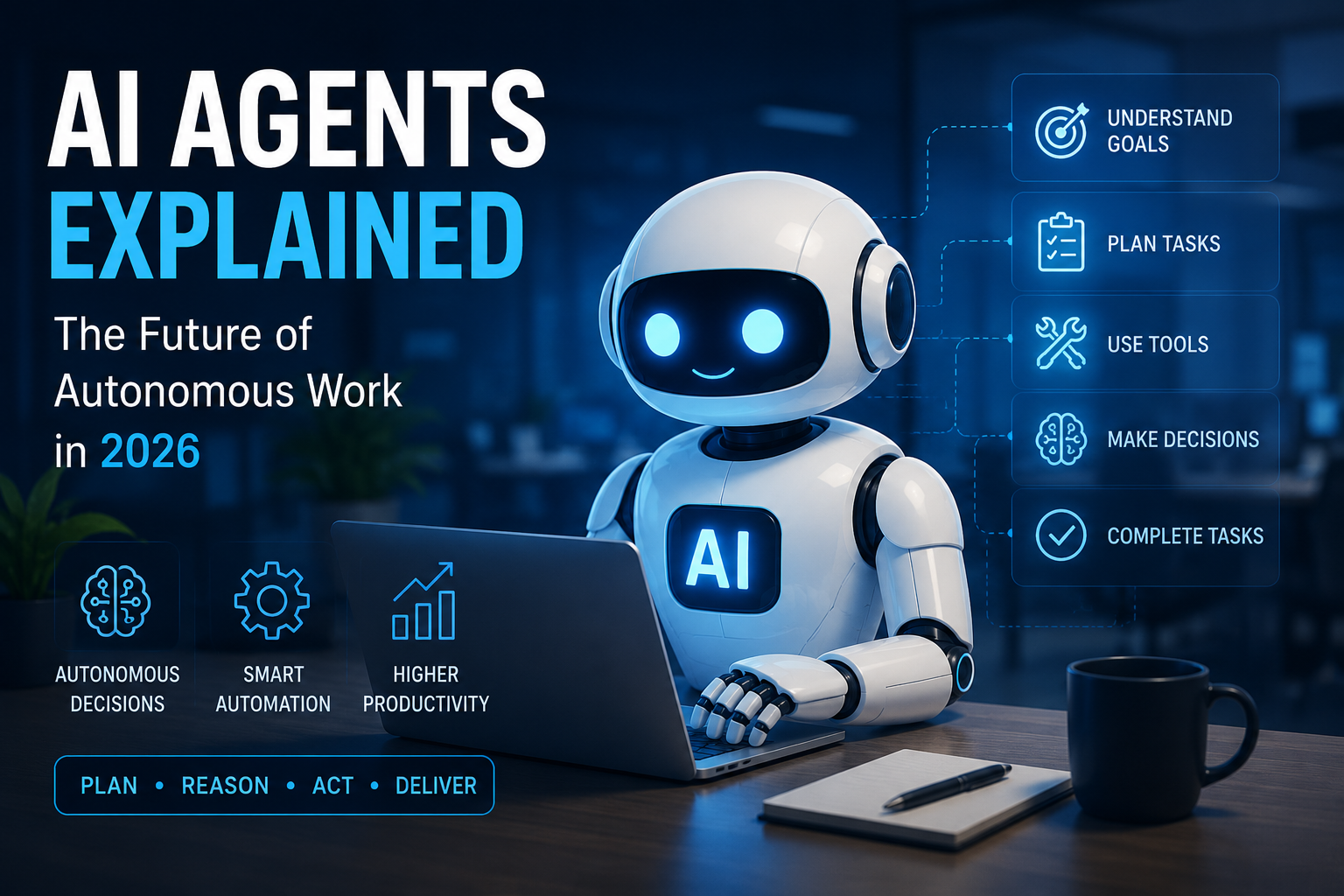
AI agents are transforming how people work by automating complex tasks with minimal human intervention. Learn what AI agents are, how they work, popular use cases, and why they are becoming the next big revolution in artificial intelligence.
AI Agents Explained: The Future of Autonomous Work in 2026
Artificial Intelligence has evolved rapidly over the past few years. While chatbots and AI assistants changed how we search, write, and code, a new generation of AI is now taking center stage—AI Agents.
Unlike traditional AI tools that respond only when prompted, AI agents can plan, reason, make decisions, and execute multiple tasks autonomously. They are becoming valuable digital teammates capable of handling repetitive work, assisting with research, automating workflows, and even collaborating with other AI agents.
Businesses across industries are increasingly adopting AI agents to improve productivity, reduce operational costs, and deliver better customer experiences.
What Are AI Agents?
An AI agent is an intelligent software system that can:
Understand goals
Break complex tasks into smaller steps
Use available tools
Make decisions
Learn from previous interactions
Complete tasks with minimal human intervention
Think of an AI agent as a highly capable digital employee rather than just an AI chatbot.
For example:
Instead of asking an AI to write an email, you could instruct an AI agent to:
Read customer feedback
Summarize common issues
Draft a response
Schedule follow-up meetings
Update your CRM
Notify your support team
All of these tasks can happen automatically.
How AI Agents Work
Most modern AI agents combine several technologies:
Large Language Models (LLMs)
These models understand natural language and generate human-like responses.
Memory
Agents remember previous conversations and important information to maintain context.
Planning
Instead of answering immediately, agents create a step-by-step plan to achieve a goal.
Tool Usage
AI agents can interact with:
Search engines
Databases
APIs
Email platforms
Calendars
Code interpreters
Business applications
Feedback Loop
Agents evaluate their own outputs, correct mistakes, and improve future decisions.
Real-World Applications
Customer Support
AI agents can answer FAQs, resolve tickets, escalate issues, and provide personalized responses 24/7.
Software Development
Developers use AI agents to:
Generate code
Fix bugs
Review pull requests
Write documentation
Perform testing
Marketing
Marketing teams leverage AI agents to:
Create blog posts
Schedule social media campaigns
Generate SEO content
Analyze campaign performance
Sales
Sales professionals use AI agents to:
Qualify leads
Draft outreach emails
Summarize meetings
Update CRM systems
Prepare sales reports
Healthcare
AI agents assist medical professionals by organizing patient records, summarizing clinical notes, and supporting administrative tasks.
Benefits of AI Agents
Organizations are adopting AI agents because they provide several advantages:
Increased productivity
Faster decision-making
Reduced operational costs
Better customer experiences
Continuous availability
Improved workflow automation
Consistent task execution
Scalability across departments
Challenges and Limitations
Despite their capabilities, AI agents are not perfect.
Some common challenges include:
Occasional inaccurate outputs
Data privacy concerns
Dependence on high-quality data
Integration complexity
Need for human oversight
Ethical and compliance considerations
Businesses should treat AI agents as assistants rather than complete replacements for human expertise.
Industries Being Transformed
AI agents are already making a significant impact in:
Finance
Healthcare
Education
Retail
Manufacturing
Software Development
Human Resources
Marketing
Customer Service
Logistics
As AI technology continues to improve, adoption is expected to grow across nearly every industry.
Best Practices for Using AI Agents
To maximize the value of AI agents:
Clearly define objectives.
Provide structured instructions and context.
Integrate reliable data sources.
Monitor outputs regularly.
Keep humans involved in critical decisions.
Review security and compliance policies before deployment.
These practices help organizations achieve better accuracy and trust in AI-driven workflows.
The Future of AI Agents
Industry experts believe AI agents represent the next major shift in artificial intelligence. Rather than simply responding to prompts, future agents will collaborate with humans and other AI systems to manage increasingly complex workflows.
We can expect AI agents to become more personalized, context-aware, and capable of handling multi-step business processes across departments. As organizations continue to invest in agentic AI, professionals who understand how to work alongside these systems will gain a significant advantage in the evolving digital workplace.
Final Thoughts
AI agents are redefining how work gets done. From automating repetitive tasks to assisting with complex decision-making, they offer organizations a powerful way to increase efficiency and innovation.
While challenges such as privacy, governance, and accuracy remain, the potential benefits are substantial. By adopting AI agents responsibly and combining them with human expertise, businesses can unlock new levels of productivity and prepare for the future of intelligent automation.
Stay in the loop
Talk to our learning advisors
Get personalised guidance on courses and career paths related to this topic — no cost, no pressure.
- Free career counselling
- Course & eligibility guidance