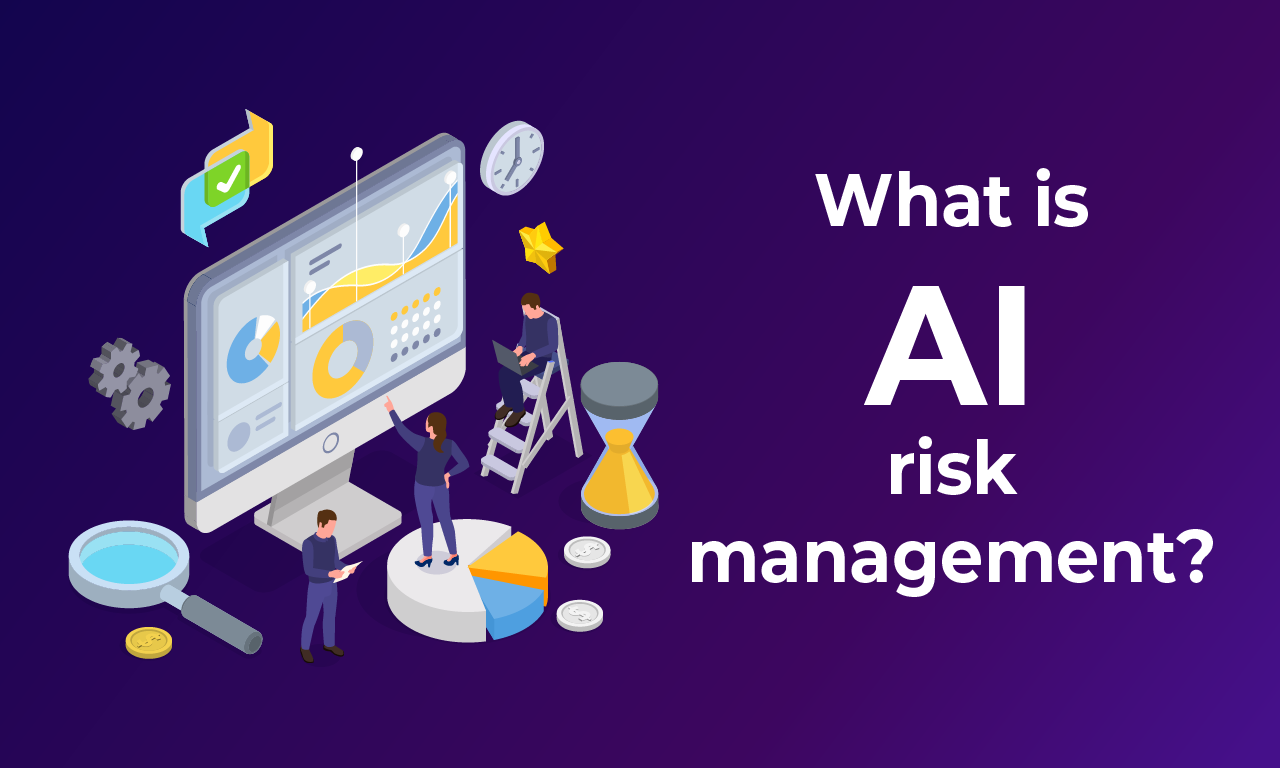
AI is quickly developing from a new technology available only to the biggest companies to a tool that all-sized companies can apply to automate their repetitive tasks, strengthen their cybersecurity, identify fraudulent behaviour, improve customer satisfaction levels, and ultimately make faster decisions.
What Is AI Risk Management? A Practical Guide for Modern Businesses
AI is quickly developing from a new technology available only to the biggest companies to a tool that all-sized companies can apply to automate their repetitive tasks, strengthen their cybersecurity, identify fraudulent behaviour, improve customer satisfaction levels, and ultimately make faster decisions.
With more and more companies involved in applying AI to their processes regularly, the associated risks of AI implementation greatly increase if there is an error or failure during use.
For example, an incomplete dataset used to train a machine learning model could result in outputs that are inaccurate. A recruitment tool could unintentionally favour one candidate over another due to algorithmic bias.
A customer service chatbot could accidentally disclose sensitive or identifying information to people that it shouldn't if measures aren't put in place to establish proper test conditions. These are just a few examples of legitimate concerns organizations will have related to the deployment of AI into their daily business operations.
This is why for many organizations that are exploring how they can use AI within their business processes at scale, developing an effective AI risk management framework has become one of their highest priorities. Instead of slowing innovation, it gives businesses a structured way to deploy AI confidently while keeping security, compliance, fairness, and reliability in check.
Understanding the Role of AI in Risk Management
Today, risk management encompasses identifying, evaluating, and mitigating risks associated with artificial intelligence (AI) systems throughout the technology's life cycle. Instead of performing a one-time risk assessment before deploying an AI model or system, organizations continuously monitor these systems to ensure they remain accurate, secure, and aligned with the organization's strategic objectives.
The primary difference between traditional software and AI is that while traditional software is programmed by rules, AI learns from data. Therefore, when an AI model learns from the data it uses to train and test, this learning changes based upon both the data available as well as the conditions it operates under. Therefore, a model that performs very well today may eventually become increasingly inaccurate months later unless the organization continually monitors and updates the model.
The risks can be best understood by utilizing an artificial intelligence risk management approach that is unlike traditional IT risk management. The AI-related risks are not merely related to infrastructure and cybersecurity; they also include risks that are unique to AI-related systems such as:
Biased or poor-quality training data
Inaccurate or inconsistent model outputs
Privacy and data governance concerns
Lack of transparency in automated decisions
Regulatory and compliance risks
Model drift as business conditions change
Why Traditional Risk Management Will No Longer Suffice
Traditional risk management methods have been utilized by businesses for decades to protect systems, data, and operations. Although some of the original principles may still apply, AI has created a new level of uncertainty that previous methods were ill-equipped to manage.
AI behaves differently from rule-based software. It makes decisions by recognizing patterns in data, and if that data is incomplete, outdated, or biased, the model can produce flawed recommendations without any obvious warning signs.
For instance, one can look at a fraud detection model to see how quickly an effective model can become ineffective. The cyber crime is ever-changing and if the AI model is not retrained with up-to-date transactional data from which it create patterns, it will begin producing inaccurate outputs due to the inability to keep pace with the speed of change within its environment. Therefore, allowing fraudulent activity to go unnoticed. This same principle can be applied across all industries and applications of AI (i.e. Healthcare, Banking, Recruiting, Customer Service) where inaccurate outputs due to an ineffective model will have far-reaching consequences.
The increased complexity in using AI for risk management has caused organizations to see how AI and risk management as highly interdependent. Instead of treating AI governance as a technical initiative, organizations are treating it as part of their overall enterprise risk management framework by including the following stakeholders: business leaders, compliance professionals, legal experts, data scientists, and cybersecurity personnel.
In addition, through AI-powered risk management solutions, many organizations are now managing their risks more effectively than ever before. AI and machine learning technologies are helping organizations to quickly identify anomalies within their operations or business models and monitor compliance with applicable regulations.
The Components of AI Risk Management Framework
Ideal governance practices within an organization does not happen by chance. It requires a structured AI risk management framework that supports every stage of an AI system, from development and deployment to ongoing monitoring and retirement.
Governance and Accountability
For proper risk management, governance and accountability are important elements. Organizations need documented policies that establish who develops, approves, monitors, and maintains AI models throughout their lifecycle.
Governance also helps define acceptable risk levels, document decision-making processes, and ensure an oversight for high-impact AI applications.
Ensuring Data Quality and Privacy Controls
AI models are only as good as the dataset used to develop and test them. If the dataset is poor, incomplete, or biased in any way, AI models will produce unreliable results regardless of the sophistication of their underlying algorithms.
Organizations must validate training data ultimately used to create the AI model, eliminate duplicate or inaccurate data, reduce potential bias where possible, and comply with applicable privacy regulations when collecting and processing personal information.
Testing and Validating AI Models
Before implementing an AI model, organizations should thoroughly test the AI model under various operating conditions. This testing will include evaluating the AI model's overall accuracy, as well as testing for fairness, explainability, and potential vulnerability through adversarial attacks.
Additionally, organizations should continue testing AI models following implementation, as AI models may degrade over time due to changes in conditions at the organization or changes in behavior by the users of the AI.
Continuous Monitoring and Improvement
Once a model goes live, the work of monitoring continues indefinitely. Models need to be continually monitored to assess performance, identify any data drift, investigate unexpected outcomes, and retrain as necessary. This ongoing monitoring also allows for the identification of compliance risks before they affect the business.
Why Generative AI Risk Management Deserves Special Attention
The emergence of generative AI generates new risks that simply didn't exist until now. Most existing governance frameworks were not developed with generative AI in mind. Generative AI produces totally new content (text, code, images, and summaries), which allows for an increase in productivity, but also increases the likelihood of factual errors, misinformation, intellectual property concerns, and accidental disclosure of confidential information.
Hence, effective generative AI risk management focuses on reducing these risks without limiting innovation. Organizations are introducing other effective ways, such as prompt filtering, human review, access controls, output validation, and internal usage policies to ensure employees use generative AI responsibly, always.
Because, ultimately, the goal is not about eliminating risk, instead, it is about enhancing practical risk management controls so businesses can benefit from the technology while minimizing avoidable mistakes.
How Organizations Are Using AI for Risk Management
AI is not only introducing additional risks within organizations but is also one of the most powerful means of mitigating risk. Organizations are increasingly utilizing AI and machine learning-based techniques for risk management to process large amounts of both structured and unstructured data, facilitating the ability for teams to identify threats much sooner than they could through manual processes. This includes applications such as:
Real-time detection of fraudulent financial transactions
Identifying unusual network behavior that may indicate a cyberattack
Monitoring regulatory compliance across thousands of business records
Predicting supply chain disruptions before they impact operations
Supporting credit risk and market risk assessments in financial services
Identifying anomalous conditions in an operation that could lead to the failure of equipment or the disruption of business.
Final Thoughts
As AI keeps becoming an integral part of business operations, the management of the associated risks is equally as important as the potential benefits that can be achieved when utilizing AI. Organizations that prioritize strong governance, high-quality data, continuous monitoring, and effective AI risk management will be better equipped to deploy AI responsibly and confidently.
In the end, success depends not only on adopting AI but on building intelligent, transparent, and trustworthy systems. Contact us today to find out how responsible AI can create sustainable growth for your business.

Stay in the loop
Talk to our learning advisors
Get personalised guidance on courses and career paths related to this topic — no cost, no pressure.
- Free career counselling
- Course & eligibility guidance