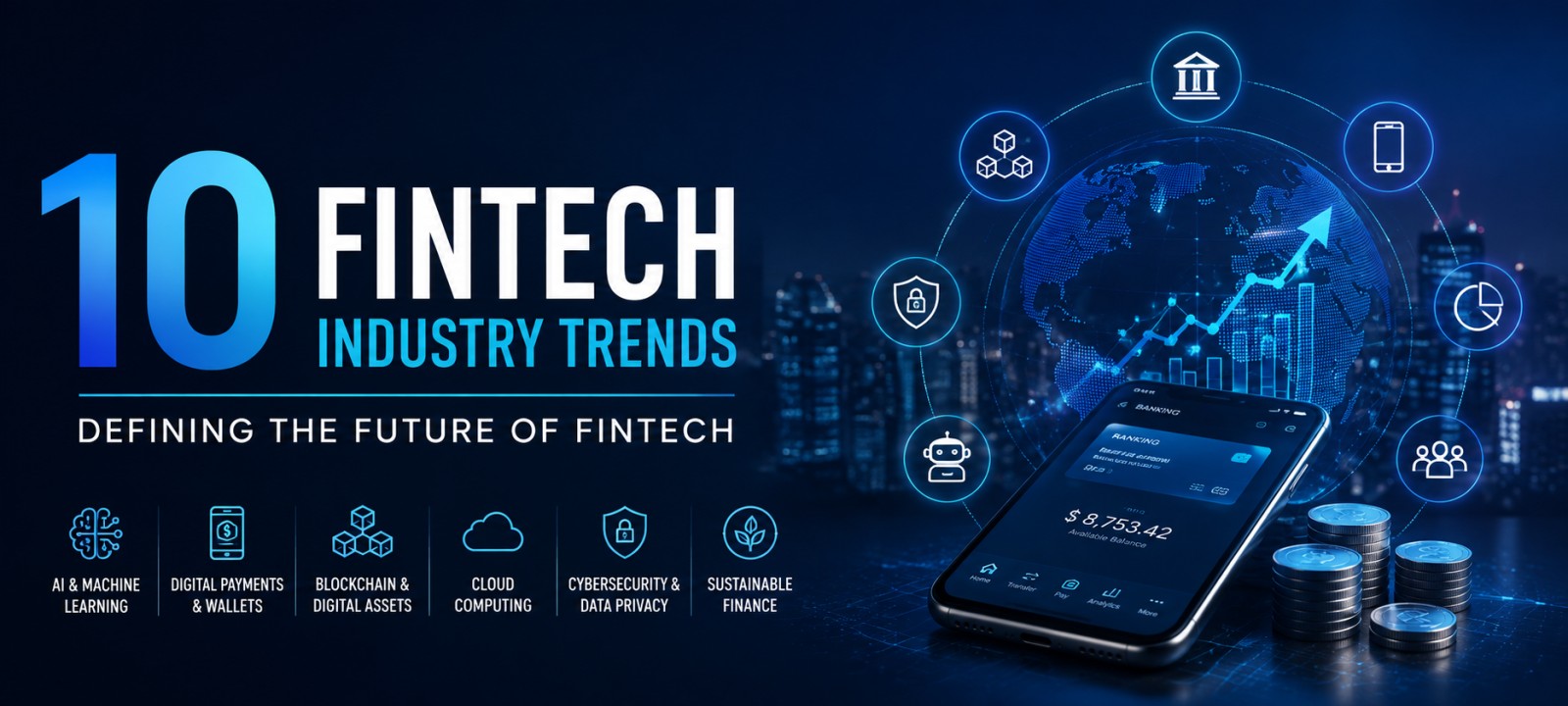
The fintech sector is not decelerating; it’s quite the opposite. Whether it is AI agents approving loans within minutes or stablecoins revolutionizing payment settlements, the fintech innovations of 2026 aren't some sort of test runs anymore. They are the new standard.
10 Fintech Trends Defining the Industry's Future in 2026
The fintech sector is not decelerating; it’s quite the opposite. Whether it is AI agents approving loans within minutes or stablecoins revolutionizing payment settlements, the fintech innovations of 2026 aren't some sort of test runs anymore. They are the new standard.
The global fintech market was valued at around $394.9 billion in 2025 and is expected to grow at a CAGR of 16.2% to reach $1,126.6 billion by 2032. Whether in the finance sector, start-up, or elsewhere, here are 10 fintech trends that are crucial to understand now.
1. Agentic AI Is Running Financial Operations
We have moved past AI as a recommendation tool. In 2026, self-directed AI agents will perform processing loan applications in real-time, rebalancing investment portfolios, and fraud detection without requiring human validation. By the end of 2025, 43% of banks would be using AI in risk, compliance, and fraud. In the finance sector alone, AI is expected to become a $51 billion industry by 2029.
There is a need for professionals with a good understanding of AI and data in this area. The FinTech Fundamentals & Digital Finance course could assist you in developing the technical base to operate with the tools that will cause this transformation.
2. Embedded Finance Is the New Distribution Model
No one is visiting banks anymore. Banks go to people. Embedded finance is the practice of incorporating lending and insurance services, along with payments, into a non-financial application — ride-sharing applications, SaaS dashboards, or e-commerce checkout.
The embedded finance addressable market is estimated to be $237.4 billion by 2029. Financial services are becoming invisible, contextual, and provided just when and where they are needed.
3. Open Banking Is Evolving Into Open Finance
87% of banks around the world have adopted open banking. Open finance in 2026 takes a step further, as you can now share investment, insurance, and pension data with fintechs, which means that you now have a 360-degree perspective on the financial life of a user.
This allows for more informed lending decisions, more equitable lending models, and truly customized offerings. Most of the consumers report that personalization makes a difference in where they bank.
4. Real-Time Payments Are the New Baseline
Instant payments are no longer just an emerging part of the infrastructure, but are also now the expected mode of operation. The transaction value for the RTP network increased by 405% from Q4 2024 to Q4 2025.
Financial institutions are likely to be 24/7 with instant settlements, real-time fraud response, and AI-powered cash flow forecasting in 2026. This equates to companies gaining quicker liquidity. For consumers, it helps to have greater control over the flow of money.
Enroll in IntelliMindz's online training courses to develop skills to pursue careers in payment infrastructure and financial tech. Instant payments have moved from emerging infrastructure to operational expectation.
5. AI-Powered Fraud Prevention Is Non-Negotiable
The US alone was estimated to have lost $12.5 billion to fraud in 2024, and some are now using generative AI to create deepfake identities and synthetic fraud profiles. Traditional rule-based fraud tools can't possibly catch up.
The AI that works in 2026 is network-level AI, which involves the detection of behavior across institutions and channels in real time. At many financial institutions, fraud investigation workloads are already being reduced by up to 20% with the help of ML-based detection tools.
6. Alternative Credit Scoring Is Opening Doors
It is estimated that most of the Americans don't have access to traditional credit. That's what fintechs are looking to change in 2026, when they'll use cash flow data, bank transaction history, utility payments, and other open banking data feeds to create a more comprehensive view of financial health.
This allows for better lending practices for gig workers, freelancers, and non-traditional earners, helping expand access without adding risk.
7. Stablecoins Are Entering Mainstream Finance
In 2024, $27.6 trillion worth of stablecoins were traded, reflecting a 90% increase in trading volume compared to the previous year. Stablecoin usage now has designated legal frameworks in both the GENIUS Act (July 2025) and MiCA regulations (Europe).
As a result, smart neobanks are taking advantage of stablecoin rails to facilitate quicker cross-border settlements, cut remittance expenses, and make programmable B2B payments in 2026. This is not crypto speculation, but a change in the infrastructure of payments.
8. Hyper-Personalization Is a Competitive Differentiator
The number of customers is declining in generic banking apps. In 2026, fintech is implementing AI-powered personalization, which tailors the interface, product offerings, and financial advice to individual actions, rather than to demographic segments.
In 2024, Bank of America's AI assistant Erica had billions of interactions, all of which were personalized. Shifting from what has happened to what to do next will help apps gain loyal customers.
9. RegTech Has Become Core Infrastructure
The days of regulatory compliance as a department are over. For mid-sized fintechs, the cost of compliance can be slashed by 30 to 50%, as AI-driven RegTech solutions automate tasks in KYC, AML, transaction monitoring, sanctions screening, and ESG reporting. Compliance should be built in, rather than bolted on after launch, as in most cases, most of the fintech data breaches were attributed to third parties.
10. Green Fintech Is Moving from Narrative to Product
Sustainable finance has become more than just a marketing buzzword; it's now a product category that can be measured. Investors are demanding that fintechs create tools for the measurement of sustainability outcomes, while regulatory requirements mandate them.
AI-driven impact analysis, tokenization of green assets, and composable ESG platforms will democratize access to sustainable investing in 2026, going beyond institutional investors.
Finance professionals who want to get into this field can choose from training courses in data analytics, AI, and finance tech, as well as sustainable finance courses.
What All 10 Fintech Trends Have in Common
All of the trends in this post have the same effect: they eliminate friction and increase control. AI accelerates the decision-making process without compromising accuracy. Open finance effectively addresses data silos while ensuring data privacy. Real-time payments are speedier and risk-free money transfers. Embedded finance is about bringing your services to where users are.
The top fintech companies of the next 10 years are not going to be those pursuing every new technology. It will be those who will be creating platforms that move fast, remain compliant, and are easy for users to use.
The Clock Is Ticking, and Fintech Isn't Waiting for Anyone
2026 isn't the time to play it safe, watching fintech on the sidelines. The world of the industry is at a point where AI is making decisions, cash is flowing in milliseconds, and financial services are embedded within an app you open dozens of times a day. There is a larger gap than ever before between organizations that adapt and organizations that don't.
Businesses have the chance to create intelligent, streamlined, and more connected financial experiences. For professionals, it's about picking up the skills that will empower them. For consumers, it's about understanding the tools now at their disposal, such as better credit, quicker payments, and more customized money management than ever before.
This is the fintech future in 2026, and it's now.
Frequently Asked Questions
What are the top fintech industry trends in 2026?
Agentic AI, embedded finance, open finance, real-time payments, AI fraud prevention, alternative credit scoring, stablecoins, hyper-personalization, RegTech, and green fintech.
What is the impact of AI on the future of fintech?
AI is gradually transforming from a facilitator to a completely autonomous worker, processing loans, fraud detection, and financial experience personalization without the need for a human operator.
Which career skills are in demand for fintech in 2026?
AI and ML engineering, data analytics, cybersecurity, compliance technology, and payment systems are the most sought-after skills.
Stay in the loop
Talk to our learning advisors
Get personalised guidance on courses and career paths related to this topic — no cost, no pressure.
- Free career counselling
- Course & eligibility guidance